CNC Router: The Future of Industrial Machining
Updated: 17 hours ago
What is a CNC Router?
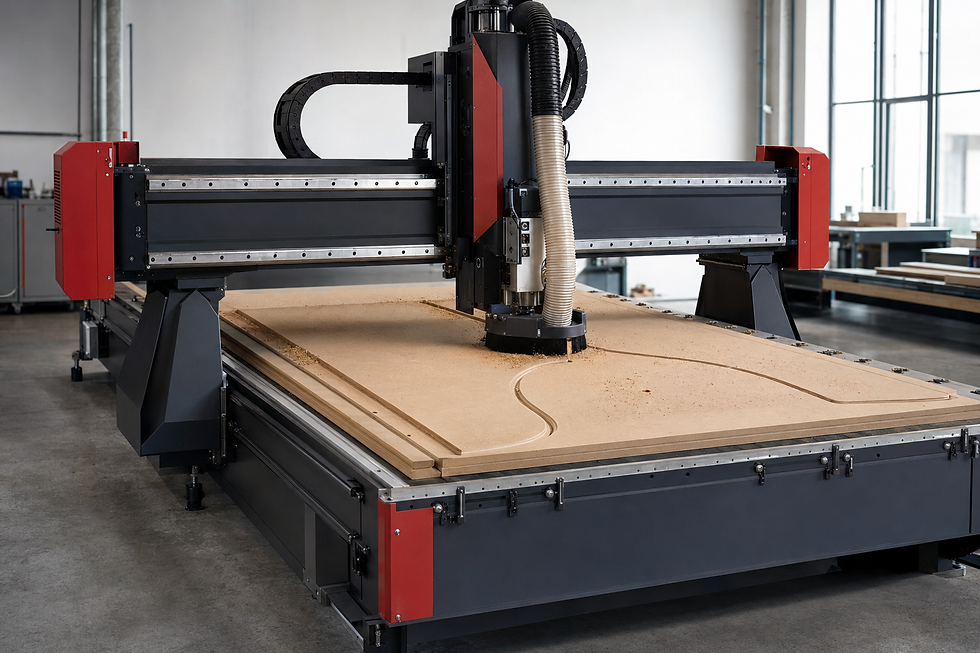
A CNC router is an industrial machine that performs cutting, drilling, channeling, and shaping operations under computer control. It can process materials such as wood, MDF, particle board, plastic, plexiglass, composite panels, and aluminum.
The abbreviation "CNC" stands for "Computer Numerical Control." The design prepared by the operator is converted into G-code, which the machine can understand, using an appropriate CAM software. The CNC router executes operations with high precision and repeatability by following these commands.
How Does a CNC Router Work?
In a CNC router system, the cutting tool is attached to a spindle motor. The machine's X, Y, and Z axes are moved simultaneously by the control system. This allows the cutting tool to move across the material according to the prepared design.
The general working process consists of the following stages:
The drawing of the product to be processed is prepared in a CAD program.
The cutting directions, depths, and tool options are determined in the CAM software.
The prepared work is converted into G-code.
The material is placed on the CNC router table and secured.
The cutting tool and work zero are set.
The program is initiated, and the machine automatically completes the operation.
Vacuum Table CNC Router Models
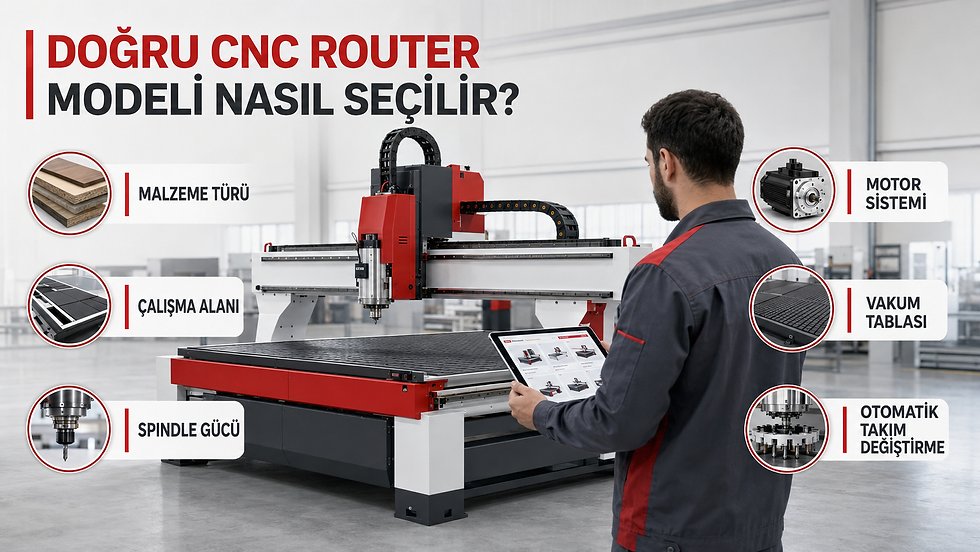
In vacuum table CNC router models, the material is secured to the surface using powerful vacuum pumps. This system significantly reduces material movement, especially during the processing of large sheets, thereby increasing cutting precision.

Advantages of CNC Routers
There are many advantages to using CNC routers. These advantages make production processes more efficient. Here are some key benefits:
High Precision: CNC routers can cut with millimeter precision. This ensures that even complex designs are processed accurately.
Repeatability: When the same design needs to be produced multiple times, CNC routers deliver the same results every time. This ensures consistency in the production process.
Variety of Material Options: They can process various materials such as wood, metal, and plastic. This offers great flexibility to meet the needs of different industries.
Time Savings: CNC routers operate much faster than manual processing. This speeds up the production process and reduces costs.
Applications
CNC routers are widely used in many industries. Here are some application areas:
Furniture Manufacturing: They are used for cutting and shaping furniture parts, making them ideal for custom-designed furniture.
Advertising: They are used in the production of signs and billboards. The ability to work with different materials facilitates the implementation of creative designs.
Automotive Industry: CNC routers play a significant role in the prototyping and production of automotive parts. Precision cutting enhances the fit of components.
Art and Design: Artists and designers can create intricate designs for their projects using CNC routers.
Conclusion
CNC routers are a revolutionary technology in industrial production. With high precision, repeatability, and a variety of material options, they play an important role in many sectors. FOURMAK aims to maintain and strengthen its position as a leading manufacturer of CNC routers and CNC laser machines in both domestic and international markets, continuously innovating to meet various industrial needs and ensure high customer satisfaction.
CNC router technology will have a broader range of applications in the future with more innovations and developments.


Comments